Months of the Year: Names, Order, Days, Season, Downloadable Chart and Quiz
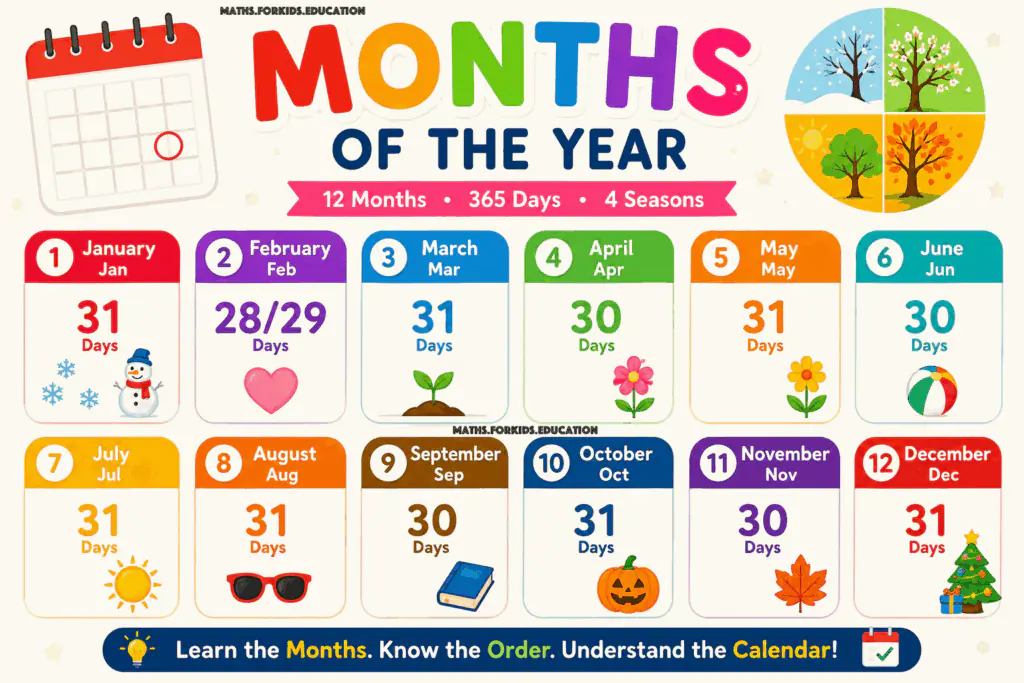
A month is one of the main parts of a year. Every year has 12 months, and each month has its own name, order, length, and place in the calendar. Once children know the months of the year in order, it becomes much easier to read dates, plan events, understand seasons, remember birthdays, and follow school or home routines.
What Are the Months of the Year?
The months of the year are the 12 named parts that make one full calendar year. They begin with January and end with December. A normal year has 365 days, while a leap year has 366 days because February gets one extra day.
Here are the 12 months in order:
- January
- February
- March
- April
- May
- June
- July
- August
- September
- October
- November
- December
Month Abbreviations
Month abbreviations are short forms of month names. They are widely used in calendars, timetables, school planners, worksheets, event notices, tickets, and date labels. For example, Jan means January, Feb means February, and Dec means December.
Jan
Feb
Mar
Apr
May
Jun
Jul
Aug
Sep
Oct
Nov
Dec
12 Months of the Year Chart
This simple chart shows the full year from January to December. It is useful for children, beginners, English learners, and anyone who wants a quick visual reminder.
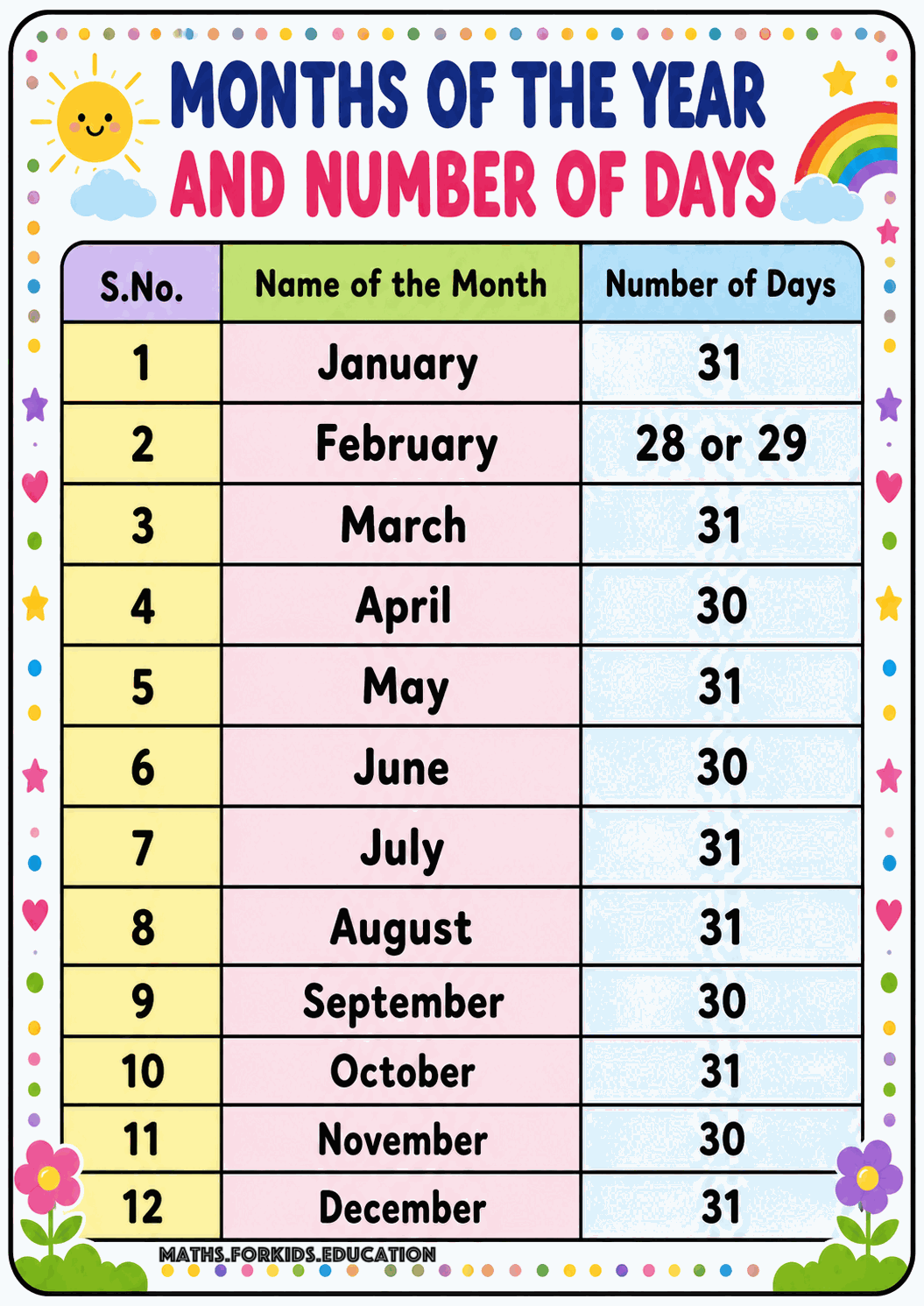
Download Month of the Year Chart With Day Counts as PDF or Image
This printable chart helps children learn the months of the year, their order, and the number of days in each month.
Month Names, Order, and Number of Days
Not every month has the same number of days. Some months have 31 days, some have 30 days, and February usually has 28 days. In a leap year, February has 29 days.
| Order | Month | Short Form | Days | Easy Example |
|---|---|---|---|---|
| 1st | January | Jan | 31 | January is the first month of the year. |
| 2nd | February | Feb | 28 or 29 | February is the shortest month. |
| 3rd | March | Mar | 31 | March comes after February. |
| 4th | April | Apr | 30 | April comes before May. |
| 5th | May | May | 31 | May is the fifth month. |
| 6th | June | Jun | 30 | June is the sixth month. |
| 7th | July | Jul | 31 | July comes in the middle part of the year. |
| 8th | August | Aug | 31 | August comes after July. |
| 9th | September | Sep | 30 | September is the ninth month. |
| 10th | October | Oct | 31 | October comes before November. |
| 11th | November | Nov | 30 | November is the eleventh month. |
| 12th | December | Dec | 31 | December is the last month of the year. |
Days in Each Month Bar Chart
This chart makes it easy to compare the length of each month. The longest months have 31 days. The shorter regular months have 30 days. February is special because it has 28 days in a common year and 29 days in a leap year.
Easy Way to Remember the Months
The easiest way to remember the months of the year is to learn them in small groups. Instead of trying to memorize all 12 at once, split them into three parts.
Start of the Year
January, February, March, April
Middle of the Year
May, June, July, August
End of the Year
September, October, November, December
- What month comes after March? The answer is April.
- What month comes before August? The answer is July.
- What is the last month of the year? The answer is December.
- What is the first month of the year? The answer is January.
Months with 31 Days and 30 Days
A helpful calendar trick is to group months by the number of days they have. This makes it easier to plan trips, count weeks, prepare school lessons, and understand due dates.
Months with 31 Days
January, March, May, July, August, October, and December have 31 days.
Months with 30 Days
April, June, September, and November have 30 days.
What Is a Leap Year?
A leap year is a year with one extra day. That extra day is added to February. So, in a leap year, February has 29 days instead of 28.
- In a normal year, February has 28 days.
- In a leap year, February has 29 days.
- A normal year has 365 days.
- A leap year has 366 days.
Months and Seasons
Months are also used to describe seasons. Seasons can be different depending on where you live. For example, countries in the Northern Hemisphere and Southern Hemisphere may experience opposite seasons at the same time.
| Season | Common Northern Hemisphere Months | Simple Example |
|---|---|---|
| Winter | December, January, February | Many places feel cold in winter. |
| Spring | March, April, May | Plants and flowers often grow in spring. |
| Summer | June, July, August | Summer is often warm or hot. |
| Autumn / Fall | September, October, November | Leaves may change color in autumn. |
This season chart is a general guide. Weather and school calendars can change from country to country.
Examples of Months in Real Life
Birthday Example
If your birthday is on 10 May, the month is May. May is the fifth month of the year.
School Example
If school starts in September, then September is the month when the school year begins for many students.
Holiday Example
If a holiday is on 25 December, the month is December. December is the twelfth and last month of the year.
Planning Example
If today is in March and your trip is in June, then your trip is three months away: April, May, and June.
How to Write Dates with Months
Months are often used in dates. A date usually tells us the day, the month, and the year. Different countries write dates in different ways, so it is helpful to know the month name clearly.
| Date Style | Example | Meaning |
|---|---|---|
| Month name first | March 15, 2026 | The month is March. The day is 15. |
| Day first | 15 March 2026 | The day is 15. The month is March. |
| Short month form | 15 Mar 2026 | Mar means March. |
Month of the Year Practice Sentences
These examples help children use month names correctly in normal sentences.
- January is the first month of the year.
- February is the shortest month of the year.
- March comes before April.
- May comes after April.
- June has 30 days.
- July has 31 days.
- August comes before September.
- October is the tenth month of the year.
- November comes before December.
- December is the last month of the year.
Interactive Fill in the Blank Quiz
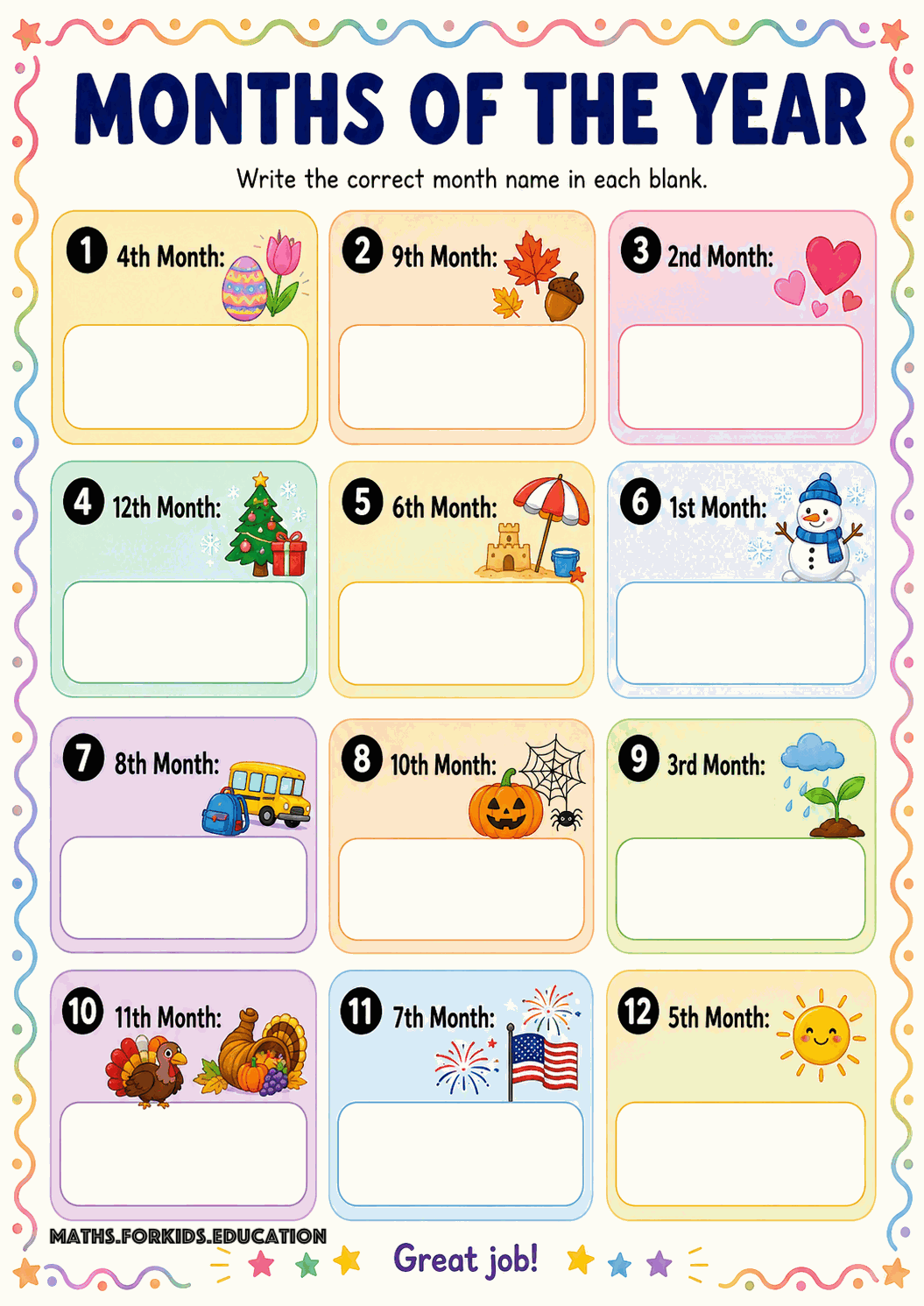
Type the missing month name in each blank. Full month names and abbreviations both work. For example, January and Jan are both accepted.
Download Month of the Year Quiz – Fill the Blanks as Image or PDF
This printable fill-in-the-blank worksheet helps children practice month names, month order, and calendar vocabulary.
Quick Summary
There are 12 months in a year: January, February, March, April, May, June, July, August, September, October, November, and December. January starts the year, and December ends it. Most months have either 30 or 31 days. February is different because it has 28 days in a common year and 29 days in a leap year.
Learning the months of the year helps with reading calendars, writing dates, planning events, understanding seasons, and following daily life more easily.
Months of the Year FAQs
How many months are in a year?
There are 12 months in a year.
What is the first month of the year?
January is the first month of the year.
What is the last month of the year?
December is the last month of the year.
Which month is the shortest?
February is the shortest month. It has 28 days in a common year and 29 days in a leap year.