A linear pair consists of two adjacent angles whose non-common sides are opposite rays. Together they form a straight angle, so their measures add to 180°.
\[A+B=180^\circ\]
The angles share a vertex and a side. Their two outer sides form one straight line.
Linear pair explorer
Enter a positive angle with up to six decimal places. The two numerical measurements stay outside the drawing so they remain clear even when a sector is narrow.
Recognize a linear pair
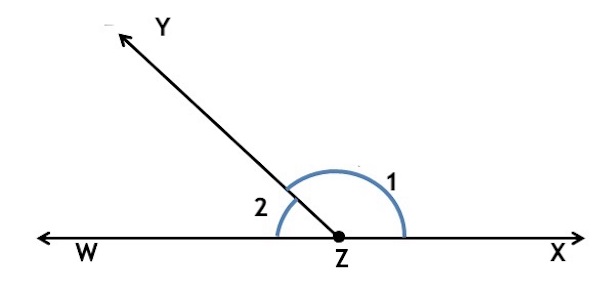
∠WZY and ∠XZY share vertex Z and side ZY. Their non-common sides, ZW and ZX, are opposite rays. That makes the two angles a linear pair.
What the definition does—and does not—say
- Every linear pair is adjacent and supplementary.
- Adjacent angles do not always make a linear pair.
- Supplementary angles drawn apart do not make a linear pair.
- The shared side need not be perpendicular to the straight line; the angles need not both be 90°.
One angle is 65°
\[B=180^\circ-65^\circ=115^\circ\]
Find both angles from their difference
Angles a and b form a linear pair, and \(a-b=40^\circ\).
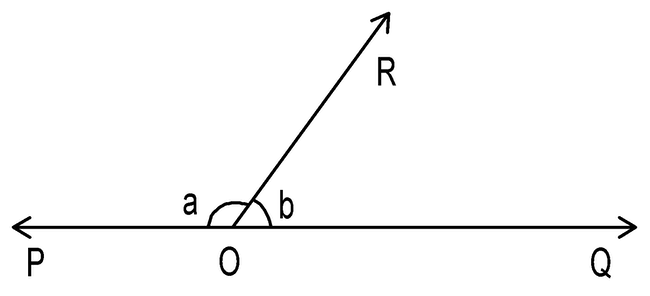
Use the sum and difference
\[a+b=180^\circ\]
\[a-b=40^\circ\]
Add the equations to eliminate b:
\[2a=220^\circ\Rightarrow a=110^\circ\]
Then substitute into the sum:
\[b=180^\circ-110^\circ=70^\circ\]
Check both conditions: 110 + 70 = 180, and 110 − 70 = 40.
Practice
One angle of a linear pair is 128°. Find the other. Then find both angles if one is three times the other.
Check the answers
52°. For the ratio problem, \(x+3x=180^\circ\), giving angles 45° and 135°.
Review adjacent angles, opposite rays, and supplementary angles.