Learn the 17 times table with a clear pattern, an equal-groups playground, and printable chart and worksheet. Split 17 into 20 minus 3: multiply by 20, then subtract three groups. You can also split it into 10 and 7.
\[17\times n=20n-3n\]
Explore groups of 17
Use the split for a harder fact
\[17\times7=140-21=119\]
Another route:
\[17\times8=10\times8+7\times8=80+56=136\]
Both methods keep the value unchanged by distributing multiplication over addition or subtraction.
Multiplication table of 17, up to ×20
| Multiplication fact | Product |
|---|---|
| 17 × 1 | 17 |
| 17 × 2 | 34 |
| 17 × 3 | 51 |
| 17 × 4 | 68 |
| 17 × 5 | 85 |
| 17 × 6 | 102 |
| 17 × 7 | 119 |
| 17 × 8 | 136 |
| 17 × 9 | 153 |
| 17 × 10 | 170 |
| 17 × 11 | 187 |
| 17 × 12 | 204 |
| 17 × 13 | 221 |
| 17 × 14 | 238 |
| 17 × 15 | 255 |
| 17 × 16 | 272 |
| 17 × 17 | 289 |
| 17 × 18 | 306 |
| 17 × 19 | 323 |
| 17 × 20 | 340 |
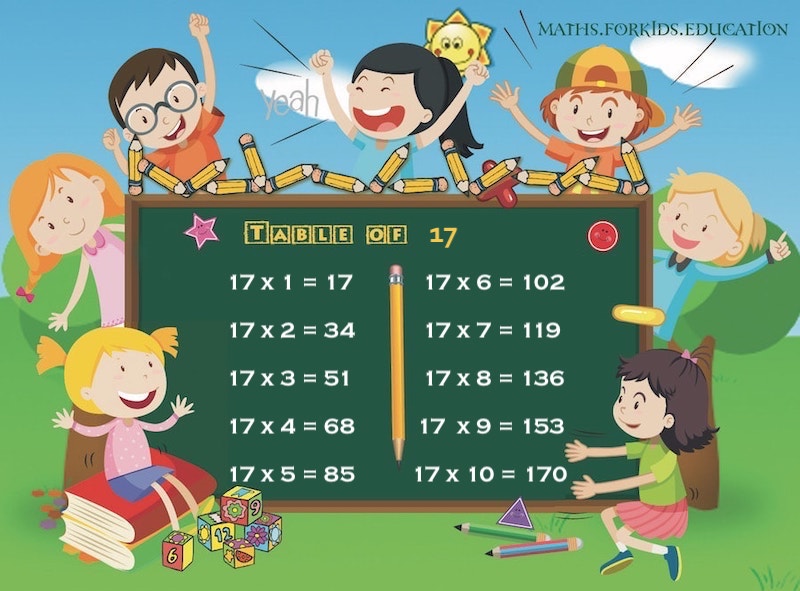
Printable 17 times table chart
Use this colorful reference for the first ten products.

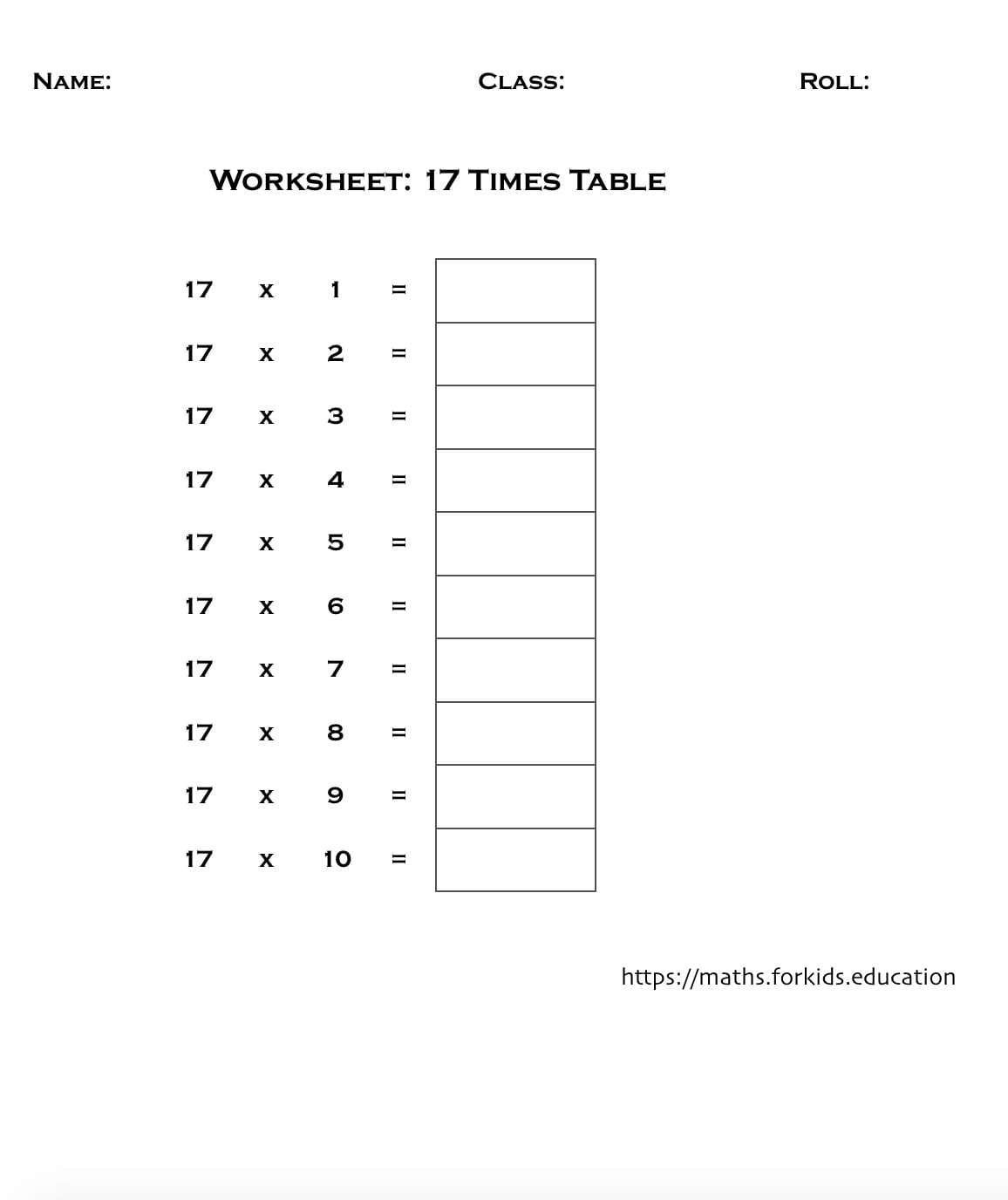
Practice worksheet
Try the facts without the chart, then check each product. If a fact is difficult, rebuild it using the split above.

Patterns and checks
Moving from one row to the next adds 17. For example, 17 × 10 = 170, so 17 × 11 = 170 + 17 = 187. Reversing the factors keeps the product the same: 17 × 4 = 4 × 17 = 68.
Try it yourself
Find 17 × 6, 17 × 9, and 17 × 12. Explain one answer using a split.
Check the answers
102, 153, and 204.
For a different table or a longer printable reference, use the table generator. Find more resources in tables 1–20.