An even integer can be divided by 2 with no remainder. An odd integer leaves one unpaired object when a positive quantity is grouped in twos. Look at the ones digit for a quick check.
Even: ends in 0, 2, 4, 6, or 8.
Odd: ends in 1, 3, 5, 7, or 9.
The rule works for positive and negative integers. Zero is even because \(0=2\times0\).
Even or odd checker
Enter an integer with up to 15 digits, including zero or a negative integer. Decimals are not classified as even or odd.
Why does the last digit work?
Every group of ten can be split into pairs. That means hundreds, thousands, and the other higher places contribute an even number of objects. Only the ones digit decides whether one object is left over.
43 is odd; 456 is even
\[43=2\times21+1\qquad456=2\times228\]
43 ends in 3 and leaves a remainder of 1. 456 ends in 6 and divides by 2 exactly.
Zero and negative integers
Even integers have the form \(2k\), and odd integers have the form \(2k+1\), where \(k\) is an integer. For example, \(-8=2\times(-4)\) is even and \(-7=2\times(-4)+1\) is odd.
You can divide an odd number by 2, but the result is not an integer. For example, \(49\div2=24.5\). Saying that an odd number “cannot be divided” is misleading.
Odd and even number chart
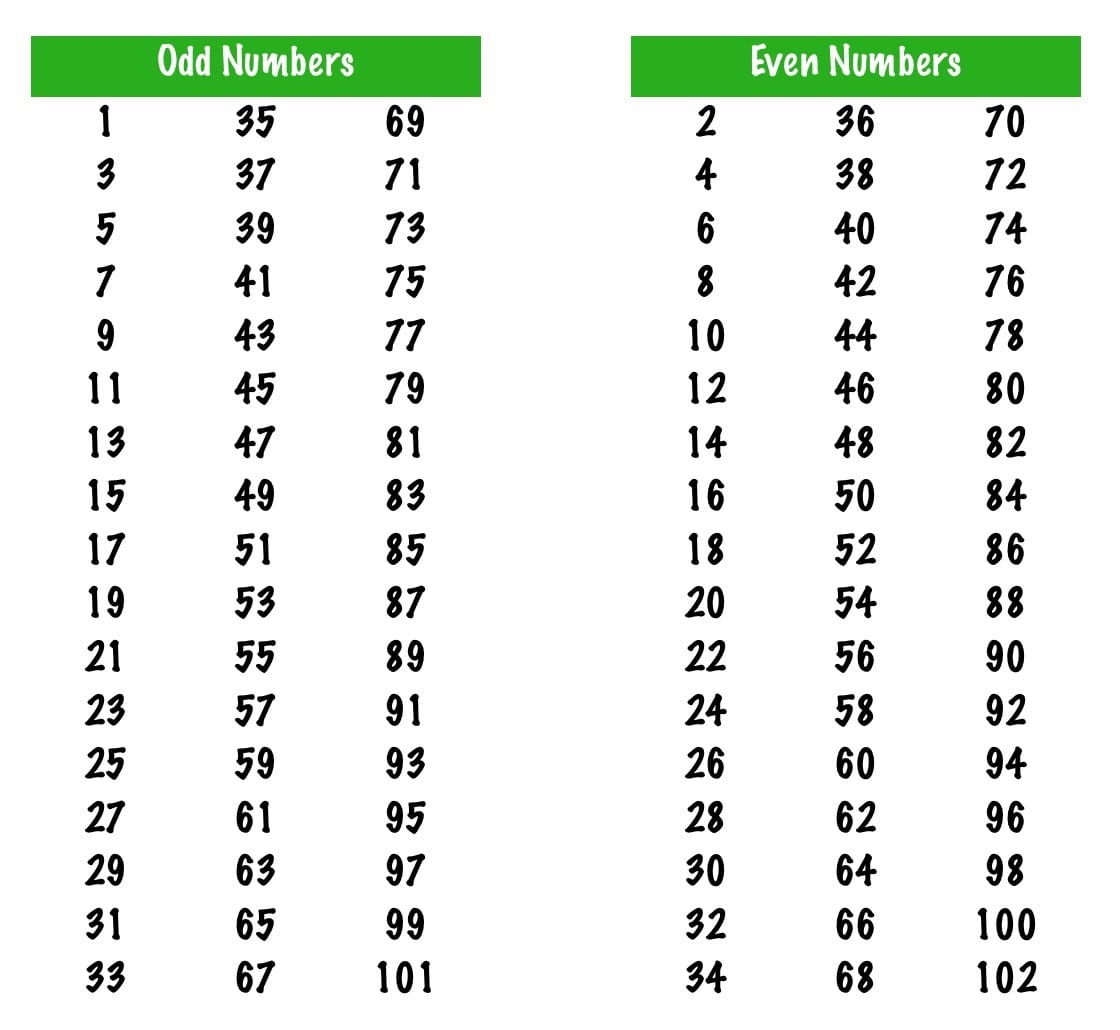
Practice with the game
Choose the answer that matches each number. Use its last digit to decide. If this older game gets stuck on the score screen, reload the page to start again.
Check your understanding
Are 120, 243, 0, and −15 even or odd?
Show answers
120 and 0 are even. 243 and −15 are odd.