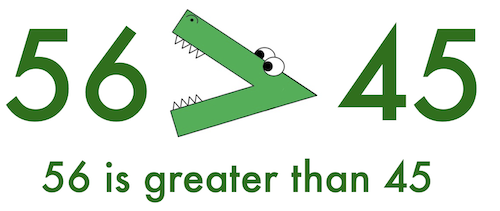
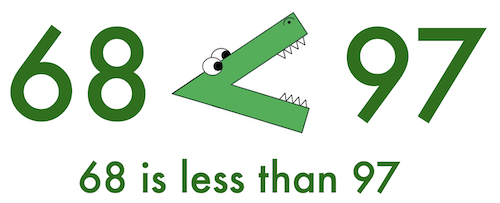
The symbols >, <, and = compare values. Read the expression from left to right: 25 > 16 means “25 is greater than 16.” The symbol’s open side faces the greater value.
| Symbol | Read as | Example |
|---|---|---|
| > | Greater than | 25 > 16 |
| < | Less than | 79 < 81 |
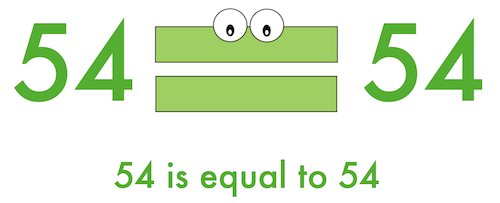
| = | Equal to | 3 + 4 = 7 |
Equal values do not have to look identical: 1/2 = 0.5 and 2 + 3 = 5. The equals sign states that the expressions have the same value.
Practise choosing a symbol
Choose a short set, answer one question at a time, and check the feedback. Your first checked answer counts toward the score. No name, email, or registration is needed.
Compare decimals by place value
Line up decimal points and add trailing zeros if helpful. Compare from the greatest place down to the first difference.
More decimal digits do not automatically mean a greater value. 0.09 has more decimal digits than 0.4, but 0.09 < 0.40.
Compare negative numbers on a number line
The value farther right is greater. −2 is to the right of −5, so −2 > −5. Every negative number is less than zero.
Reversing a comparison
If you exchange the two sides, reverse the inequality symbol: 9 > 4 becomes 4 < 9. Equality remains equality when its sides are exchanged.
Practice
Compare 0.30 __ 0.3, −4 __ −1, and 2/4 __ 0.5.
Check the answers
0.30 = 0.3; −4 < −1; 2/4 = 0.5.
Printable symbol references



More comparison games
Drag and drop a symbol
Move the symbol that makes each statement true. Use the activity’s Check option before moving on.
Choose the matching symbol
Read the comparison attached to the pointer and select its correct symbol. Reload this page if the older game stops at its score screen.